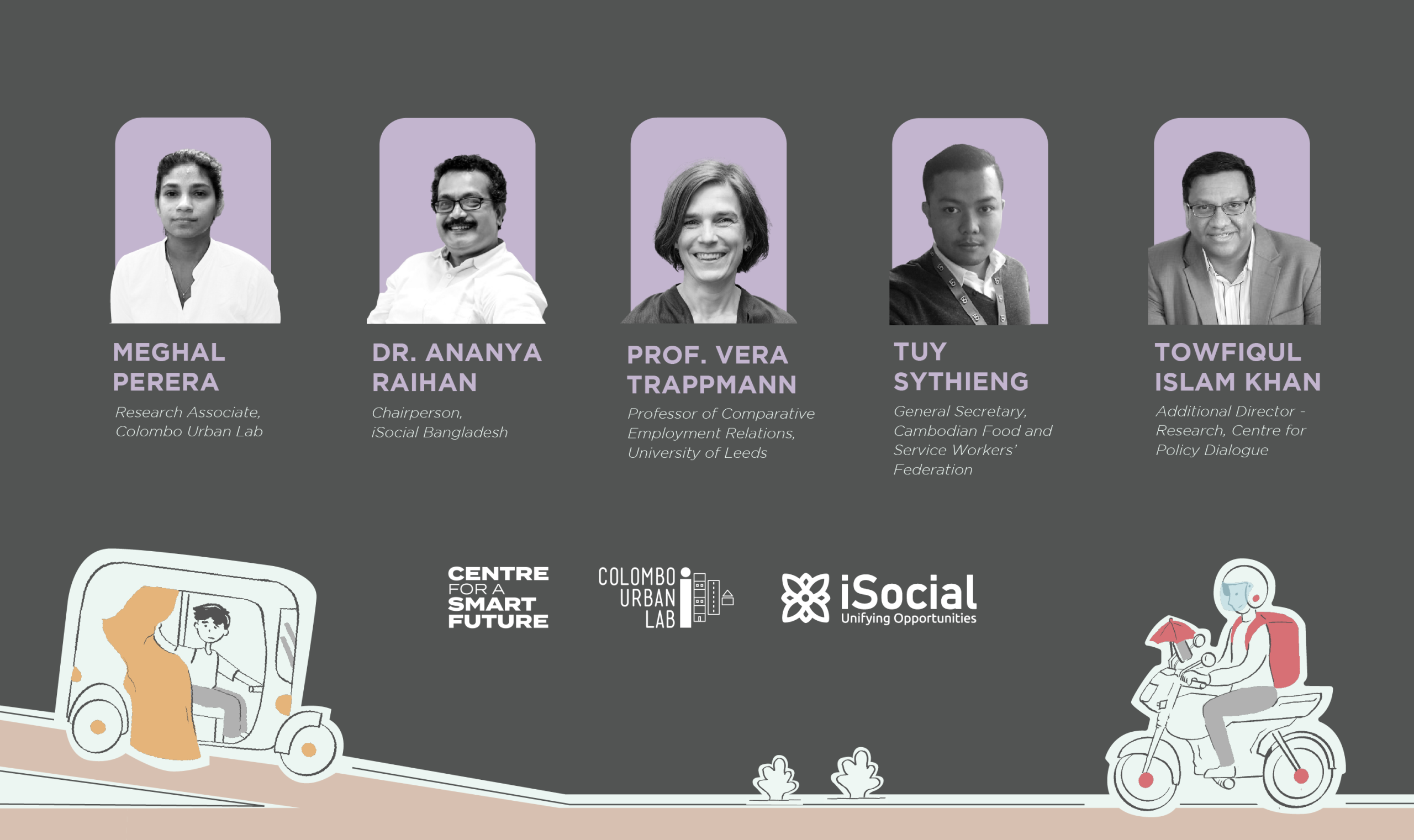

Across Asia, more workers are turning to gig platforms as a primary source of income amid persistent fiscal pressures. Yet ride-hailing drivers, food-delivery riders, and digital freelancers operate on platforms that promise flexibility, but offer few of the protections afforded to those in formal employment. This precarity makes the ILO’s 114th International Labour Conference, held in Geneva from 1-12 June 2026, a critical moment as deliberations of the landmark convention on Decent Work in the Platform Economy have set a global baseline for the rights of millions of gig-workers worldwide. The question is whether it will adequately reflect Asian realities. To address this, Centre for a Smart Future, in collaboration with iSocial Bangladesh, convened this webinar on 10 June 2026. This discussion brought together Dr. Ananya Raihan, Chairperson of iSocial Bangladesh; Dr. Towfiqul Islam Khan, Additional Director of Research at the Centre for Policy Dialogue; Tuy Sythieng, General Secretary of the Cambodian Food and Service Workers’ Federation; Prof. Vera Trappmann, Professor of Comparative Employment Relations at the University of Leeds and Meghal Perera, Research Associate at the Colombo Urban Lab, to contribute an Asian perspective to the global conversation and identify what policies are needed to build a gig-economy that is both free and fair.
The event opened with Meghal Perera from the Colombo Urban Lab, who situated the discussion in the Sri Lankan context. Her remarks centred on the intersection of climate and labour where Colombo’s variability in weather, from extreme heat to prolonged rainfall, creates a unique set of hazards for outdoor work. Perera noted that while extreme weather creates demand-side benefits with order volumes rising during heat and rain, it remains unclear whether workers actually earn more, given simultaneous cost pressures around fuel and protective apparel. A gender dimension was also flagged; while women are already underrepresented in gig-work, those who do participate face trade-offs (leaving a shift early, limiting water intake) that translate directly into lost income and health risks. Several policy recommendations emerged, including the need to invest in worker-friendly public infrastructure, strengthen social protection frameworks and support worker adaptation without shifting costs onto workers themselves.
Dr. Ananya Raihan of iSocial Bangladesh followed, and framed precarity in gig work as market failure rooted not in technology but in political economy. Digitalisation, he argued, has recast workers as “independent contractors” to strip them of employment protections while maintaining control over them. In Bangladesh, this is amplified by high unemployment and a vast informal labour pool that leaves workers with little bargaining power. Platforms exploit this to reduce incentives, increase commissions, and externalise costs onto workers, leading to a “fundamental shift in economics where employers shift major fixed and variable costs to gig workers”. Because of this phenomenon, one consequence is that it is estimated that a Bangladeshi worker must log 108 hours to earn a viable income. Beyond pay, unilateral contract changes are imposed without negotiation, and deactivation comes without due process. Workers continuously generate valuable information on routes, behaviour, and performance that platforms capture and commercialise, yet workers receive no share of that value and remain largely in the dark about how it is used.
The discussion also highlighted the resistance strategies workers have developed in response to platform constraints. One example is a practice where drivers arrange rides directly with customers, cutting out the platform entirely to retain a greater share of their earnings. Rather than treating this as misconduct, Raihan read it as a rational response to injustice: “This is a response to structural injustice; it is not worker misconduct. The platform benefits from flexible, low-cost labour. The consumer benefits from cheap rides. The government benefits from the digital innovation narrative.” The problem noted was the low incentive for any actor (platform, consumer or the state) to disrupt the status quo. On the question of what needs to change, it was stated that governments must recognise platform workers in law, regulate commissions, and introduce portable social protections. Platforms must also move from value extraction to sharing value by paying livable wages, creating transparent structures, and protecting worker data. Civil society supports this by advocating for workers, promoting digital rights literacy, and holding all parties accountable.
Dr. Towfiqul Islam Khan approached the question from a policy design angle. He proposed a theory of change built on recognition that gig work must first be formally acknowledged within national legal and employment frameworks. He noted that in Bangladesh, gig work is predominantly taken up by young, moderately educated workers for whom it has become a permanent occupation rather than a supplementary one. Yet legal cover remains absent, with employment policy containing no specific mechanism to account for platform work. On social protection, the inadequacy of existing arrangements was stressed; accident cover offered by platforms is voluntary and non-portable, and workers with very low base pay and commission-dependent earnings have an interest in social insurance but a limited ability to pay for it. The suggestion emerged that a government-led programme could bridge this gap by bringing together platforms, workers, and insurance service providers under a unified insurance and pension scheme.
Tuy Sythieng, brought in perspectives of trade unions operating to specifically advance the rights of food delivery workers. The post-pandemic contraction of Cambodia’s manufacturing and garment sectors drove a surge in gig-work, making platform employment a critical yet largely unprotected source of income. Workers must also pay significant upfront costs, needing approximately USD 2,000 in capital for a bike, fuel, and bank registration before they can begin earning. He highlighted that once on the platform, algorithmic control is constant with GPS tracking monitoring workers around the clock and dictating their routes, which can total around 300 kilometres a day.
The gendered effects are acute, with women being offered no maternity protection policy from platforms, and no childcare provision, leaving women to choose between bringing children to work or losing income. On collective action, Cambodian law does not recognise gig-workers as employees, meaning trade unions cannot legally be formed. Despite this, Sythieng explained how his organisation advanced labour rights through organising petitions, solidarity strikes, and educating workers about their rights under international labour conventions. The conditions on the ground are perhaps best summed up by workers themselves: “food delivery workers feel they pay money to the company to become a modern slave”.
Prof. Vera Trappman closed the speaker presentations with findings from the Leeds Index of Platform Labour Protest, a database she helped develop to track worker protest incidents in the gig economy globally since 2017. The index draws on the Global Database of Events, Language and Tone (GDELT) project, a real-time news search tool covering over 100 languages, and categorises actions across a spectrum from strikes and logoffs through to demonstrations, legal action, and institutionalisation. Geographically, protest activity is concentrated in Europe, the United States, and India, with a notable spike in 2020 driven by health and safety failures during the pandemic. This was followed by a decline in recent years that may reflect some improvement in worker movement successes. The platform identified as most targeted globally in protests was Uber. A key finding from the index is that platform worker protests are driven primarily by pay, not regulatory issues, which creates direct implications for how advocacy campaigns are framed. In Southeast Asia specifically, protests are organised predominantly by informal groups rather than mainstream trade unions, with demonstrations and log-offs being the most common forms of action. Trappmann noted that climate change is likely to intensify health and safety concerns and could become a significant driver of protest in the years ahead.
The Q&A session brought forward several important points. Protest activity in countries like Bangladesh is likely underreported, with documented resistance against Uber’s commission structures serving as one example that rarely surfaces in global databases. On the question of whether European legislation could serve as a model for Asia, an example from Germany was shared, where drivers who won employee classification gained access to works councils, making clear that legal status is a determinant in gaining essential rights. The UK Supreme Court’s recognition of ride-hailing drivers as workers, but not delivery workers, was attributed to market competition where ride-hailing faces pressure from the established taxi industry, a precedent that food delivery lacks. More broadly, gig work cannot be treated as a purely national policy question given that platforms are global, making a rules-based international framework increasingly necessary.
View the full webinar recording on YouTube here.