
Panel Discussion Highlights: Social Protection and Urban Infrastructures of Care in Colombo
Colombo Urban Lab launched its latest report, “Social Protection and Urban Infrastructures of Care in Colombo” on the 19th of January 2026. Urban working-class households in Colombo have been disproportionately affected by Sri Lanka’s polycrisis, facing shocks that have led to increased household debt, nutritional deficiencies and time poverty. This report examines urban infrastructures of care; the specific environmental and social factors that support or hinder caregivers, and highlights how existing social protection systems have failed to address the unique vulnerabilities of the urban poor.
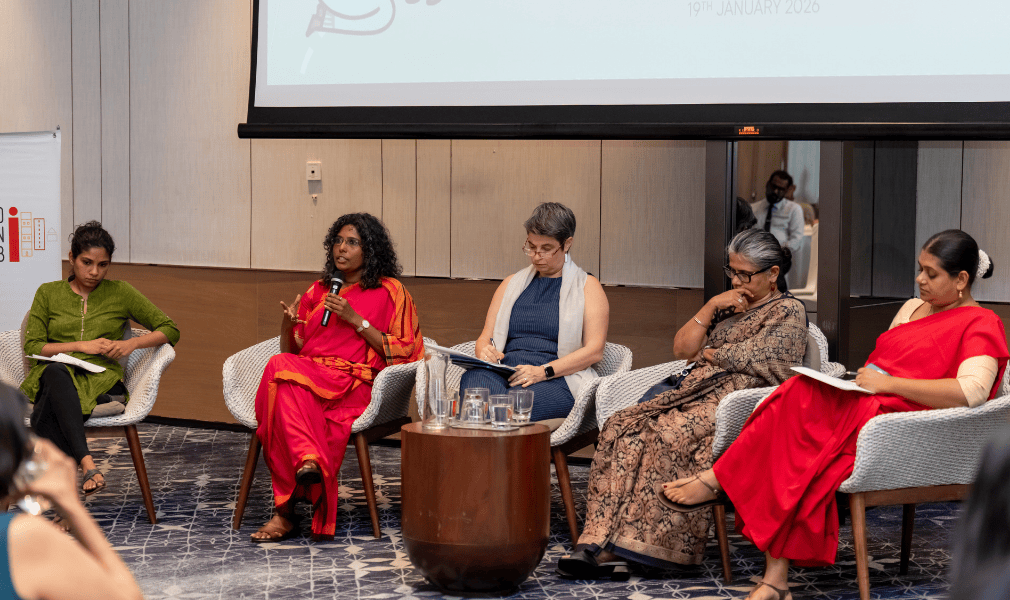
The presentation of the report’s findings was followed by a panel discussion on recommendations for improving care infrastructure and social protection and what opportunities and roadblocks lay ahead in catalysing change. The panel consisted of Vraîe Cally Balthazaar, incumbent Mayor of Colombo, Dr. Farzana Haniffa, Commissioner of the Human Rights Commission of Sri Lanka, Emma Brigham, UNICEF representative for Sri Lanka and Iromi Perera, Director of the Colombo Urban Lab.
On the lived realities of urban care in Colombo
The discussants shared insights on the status-quo for urban working-class women; defined by deep-seated time poverty and a fragile care network that was severely tested by Cyclone Ditwah. Vraîe Balthazaar highlighted how the relocation under the Urban Regeneration Programme in Colombo has eroded traditional support systems, noting that mothers who once could “leave their child at a neighbour’s house” in settlements now lack those same support structures in high-rise complexes. Vulnerabilities are exacerbated by natural disasters such as the cyclone; Emma Brigham observed that care networks and its corresponding structures absorbed the impact of Cyclone Ditwah. When state support lags in such instances it is grandparents, relatives and neighbours who step up to accommodate displaced, fractured or out-of-work families.
The discussants also underscored the gendered exhaustion inherent in the space of care work in urban settings. Iromi Perera pointed out that women often sacrifice using electric home appliances to save on electricity, instead opting for cost-effective yet more intensive alternatives to household work while simultaneously taking on second and third jobs to contribute financially to their household. On top of these responsibilities, Brigham added that “it is the women who must drop out of work for months on end” when another family member becomes ill or requires hands-on care, highlighting the unequal gendered burden of care placed upon women in working class urban households.
On the need for a transformation of social protection and formal institutionalisation of care support systems
The panel emphasised that addressing Sri Lanka’s care crisis requires an outright transformation of social protection through a “constellation of policies” and an approach that is universal, integrated and centred around the life-cycle.
The life-cycle approach recognises that anyone can be vulnerable at different life stages. Emma Brigham supported this, noting that protection must capture all requirements from young children to ageing parents to ensure no cohort is excluded. Vraîe Balthazaar highlighted the practical necessity of this approach, noting that the Colombo Municipal Council (CMC) is expanding its daycare facilities to include elder care alongside childcare, as many women are unable to work due to the responsibility of managing elderly parents at home.
It is imperative that social protection is understood as a right and not as charity. Expanding on universal social protection, Brigham noted that a universal approach is “more affordable, more efficient and more comprehensive” because it eliminates the need for women to “waste time trying to prove that they are eligible”. Dr. Farzana Haniffa argued that a thorough recognition of care work on a national scale would be a “game changer” for economic growth.
Brigham also expanded on taking a more integrated approach to social protection, to “bring the package together,” exemplified by ‘cash-plus’ disbursements. This ensures cash support is “complemented by information” on healthy nutritional practices, upskilling initiatives or where to “raise concerns if support is lacking” for vulnerable households in order to make social protection a more holistic form of support opposed to a purely monetary one.
The devastation of Cyclone Ditwah highlighted the urgent need for transformative social protection. While Balthazaar noted that at the CMC, provisions to support constituents food and aid within days are already in place, consensus among the panel was reached that recovery following such disasters and crises going forward would see large improvement if social protection was digitised and made electronic to facilitate rapid transfers. While acknowledging that Sri Lanka’s National Social Protection Strategy in 2025 includes many of these transformative elements on paper, Perera and Haniffa warned that success depends on whether the government “makes the care economy a priority”.
On challenging the paternal role in urban households and reimagining care as not just ‘women’s work’
The panel discussants agreed that a key hindrance to female labour-force participation and general gender equity in urban households was a “reluctance on the part of men to provide care” to alleviate the gendered exhaustion of wives and mothers. Dr. Haniffa argued that “care work as men’s work” needs to become a prominent discussion to be had nationally. Emma Brigham agreed on the necessity of reimagining the roles that fathers have to play in the household, with specific regard to childcare, though she acknowledged that “changing that sort of mindset [does] take time”.
On current interventions, constraints and the road ahead
Concerning ongoing initiatives to address the needs of the care economy in Colombo, the panel discussed the existing roadblocks that impede the support and formalisation of care work in urban Sri Lanka and what can be done to address them moving forward. Mayor Vraîe Balthazaar detailed that the CMC already operates a “robust” public assistance department and the country’s sole charity commission, supporting 13,000 residents in the city and currently managing 12 pre-schools and 3 daycare centres. However, she mentioned that existing daycares only serve children up to age five, a limitation Balthazaar identified as critical because the need for such care “doesn’t ‘end’ at five.” To address this, she mentions that the CMC has allocated 80 million rupees for four new centres and building out teacher training facilities to build capacity within the CMC’s daycare centres and allow a more inclusive and wider age-range of children to be accommodated, on top of their efforts to integrate elderly care into their services as well. Beyond expanding the CMC’s care infrastructure, Balthazaar also highlighted a commitment to improving quality of existing care services, namely by creating more nutritious menus in daycare centres and pre-schools and increasing payments for community staff and teachers.
The panel then turned to the value of multi-sectoral collaboration and community activism to address the needs and challenges of care work, with the mayor emphasising the CMC’s push to keep seeking help from “development agencies, embassies, and CSOs” for knowledge-sharing and funding in its efforts. And finally, before its conclusion the conversation oriented itself to the audience (and wider public), with a call to engage with their local representatives to legislate and create legal provisions for those engaged in domestic and professional care work, volunteer their time to help local NGOs and community initiatives and disseminate this report’s (and equivalent) findings to help catalyse change and create a more supportive, inclusive and resilient care economy not just in Colombo, but nationally.